Streaming amplifier In development

Brahma. Real speakers. Real sound. Your rules.

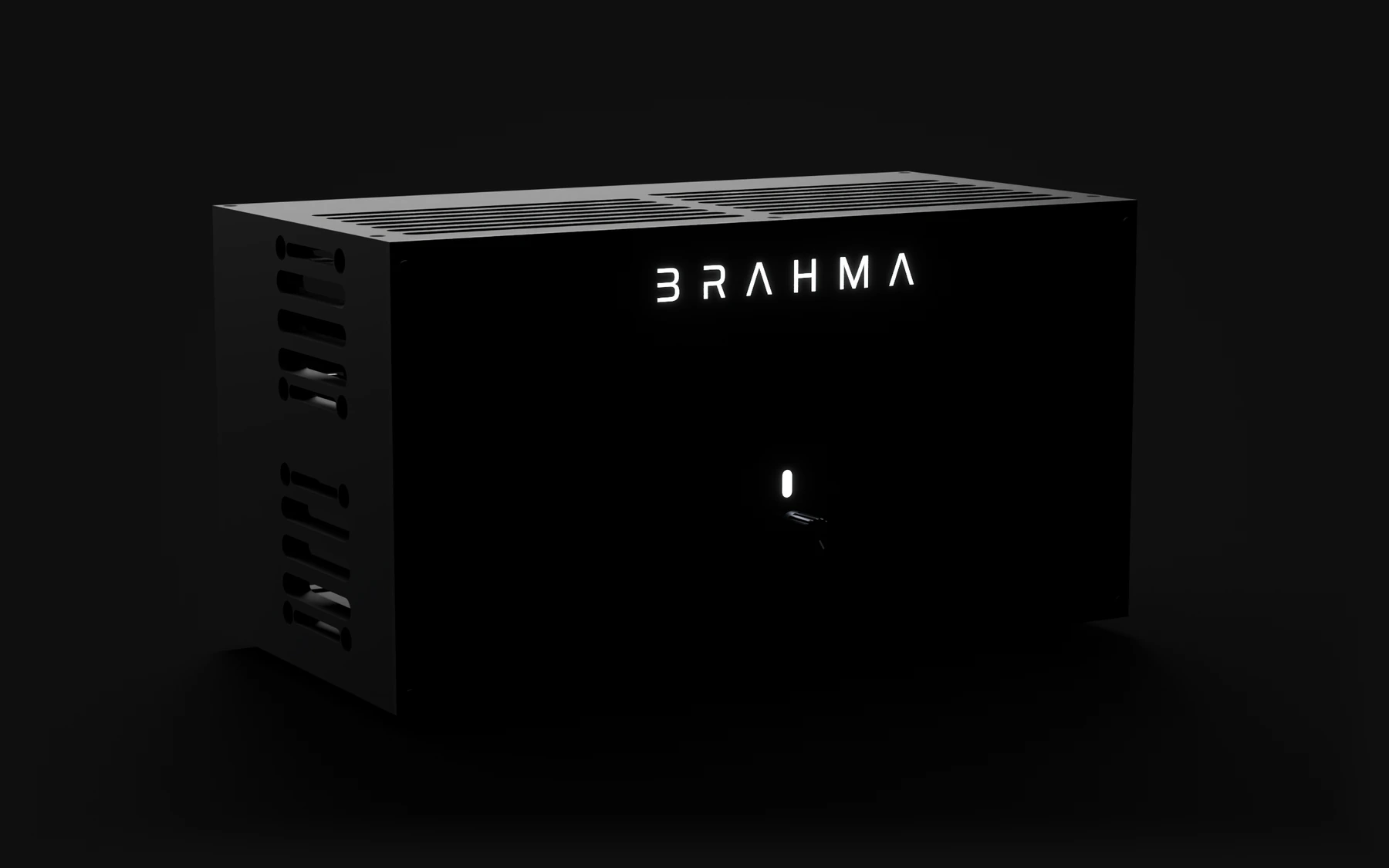
Brahma in the dark: a black rectangular amplifier with its wordmark and status light glowing white
Power up to
2 × 175 W
Into 4 Ω speakers
Inputs
9
From optical to Wi-Fi
Line out
112 dB
Reference DAC feed

Pick your speakers, shape your sound, and hear your room the way it was meant to be heard.

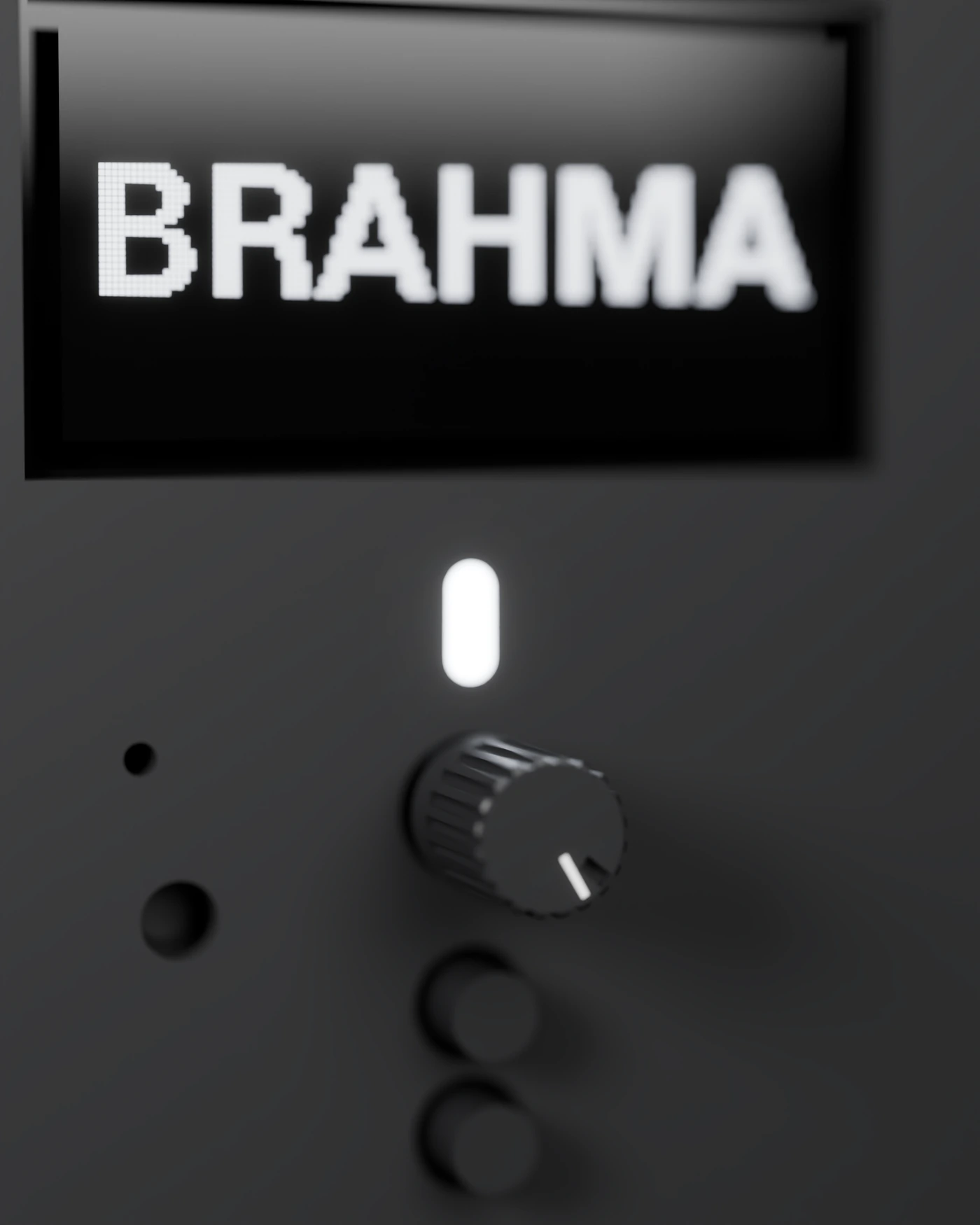
Close-up of the OLED display showing the BRAHMA logo, the glowing status light, the knurled volume knob and two push buttons

01 One box, every source

Whatever you want to play, just plays.

Streamer, DAC, amplifier and input switch, folded into one — every digital path handled bit-perfect. Nine ways in, and two ways out: your main speakers, and a reference line output for everything else.

Honest by default, natural reproduction — it stamps no house sound on your music. But when you want to shape it, the control is yours: 11 bands of parametric EQ per channel, allowing you to tune your sound around your world. Choose the speakers you fall for, tune them to exactly what you love, and change your mind as often as you like.

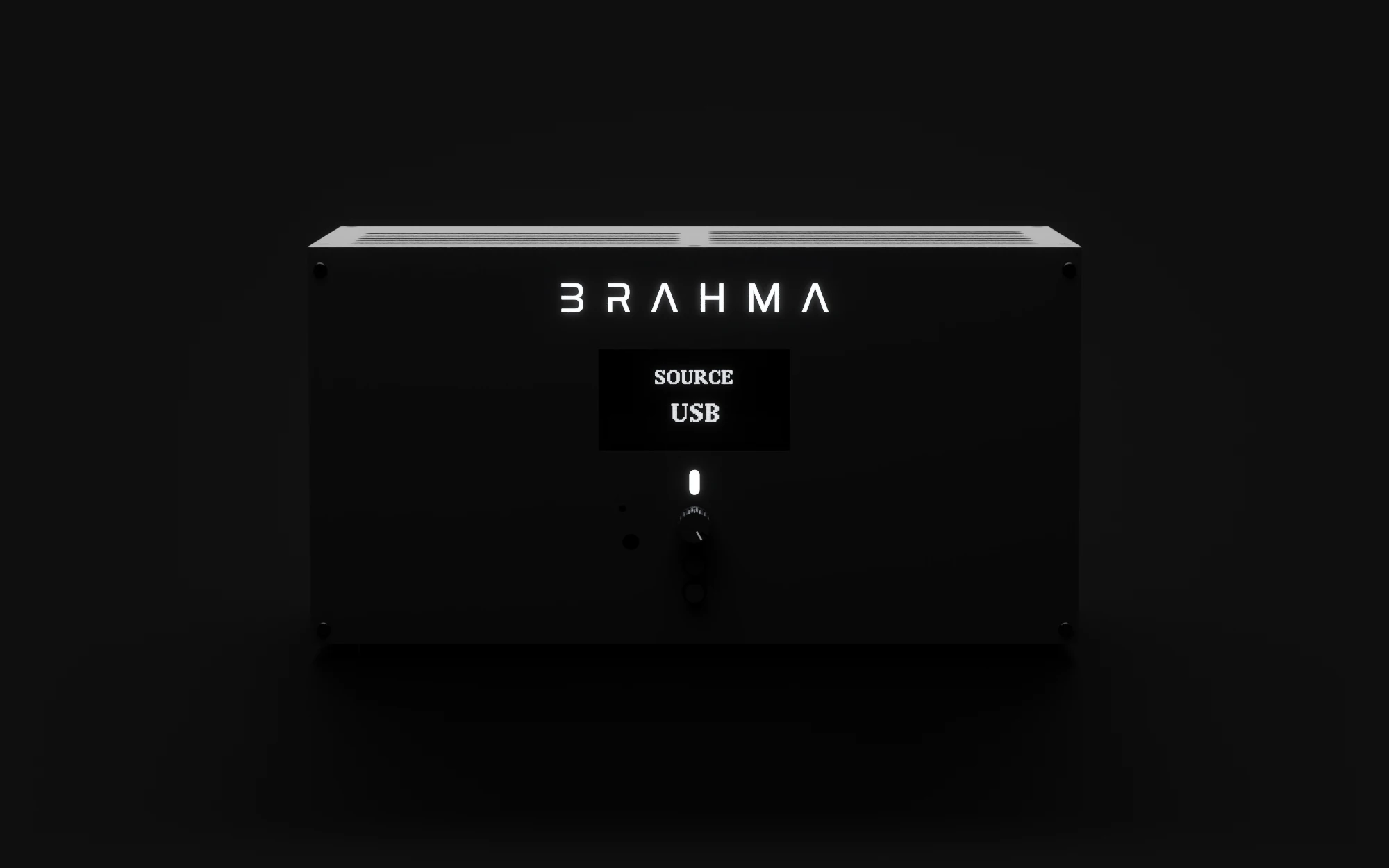
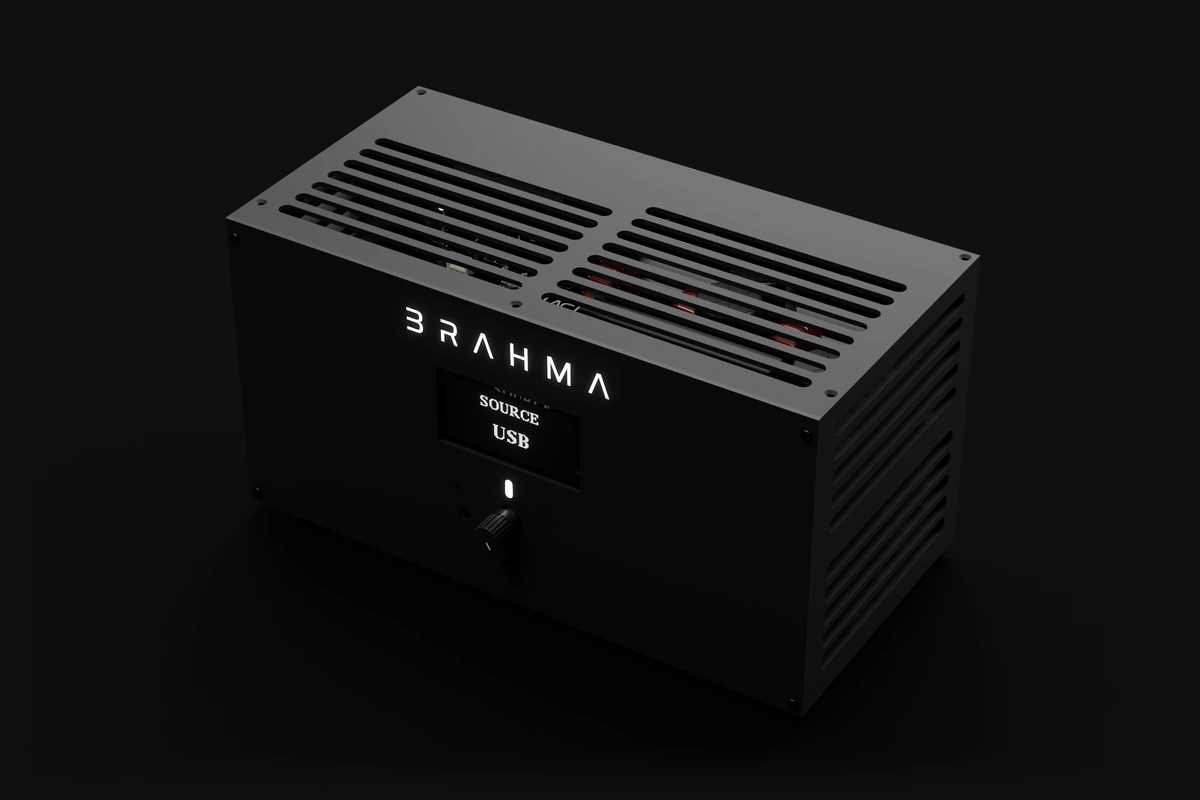
Brahma from the front, the display reading SOURCE USB

In

2 × Optical · TOSLINK
TV, console, CD transport — two digital sources ready
Coaxial S/PDIF
A second wired digital transport or streamer
HDMI ARC + CEC
One cable to the TV, and one remote: TV volume and power drive brahma
Analog line-in
Turntable preamp, tape, any legacy source
USB Audio · asynchronous
High resolution from a computer, up to 24-bit / 96 kHz
Bluetooth · QCC5125
The hi-res codecs: aptX Adaptive, aptX HD, AAC
AirPlay · Spotify Connect
Native and gapless; your phone stays free

Out

Stereo speakers
Up to 175 W per channel into 4 Ω of clean Class-D
Reference line-out
A 112 dB DAC feed — a subwoofer, a second amplifier or a headphone amp

02 Where it started

Physics doesn’t fit in a bar.

The project began the day a simple soundbar could no longer carry the show.

Understanding sound means understanding how air moves, and that means understanding that everything matters: the cabinet’s volume, its material, its size, its shape, even its position in front of you. Try to take your home setup a step further and do the math, and you will soon find that “compact” solutions simply can’t reproduce the sound you’re after. That is not a concept; that is what physics says.

That is how the idea was born: the convenience of a compact system, in a build that doesn’t choose the speakers for you, and that is physically capable of delivering the sound you want.

Also, I want to keep the brain and the voice apart, so each can change without touching the other. If a speaker fails, you should only have to replace that speaker, with everything else staying as you left it. When you want more, you should be able to add a subwoofer or move to a different pair whenever you like. And because the brain runs on firmware, I want every update to keep improving what you already own.

03 Inside

Designed from the silicon up.

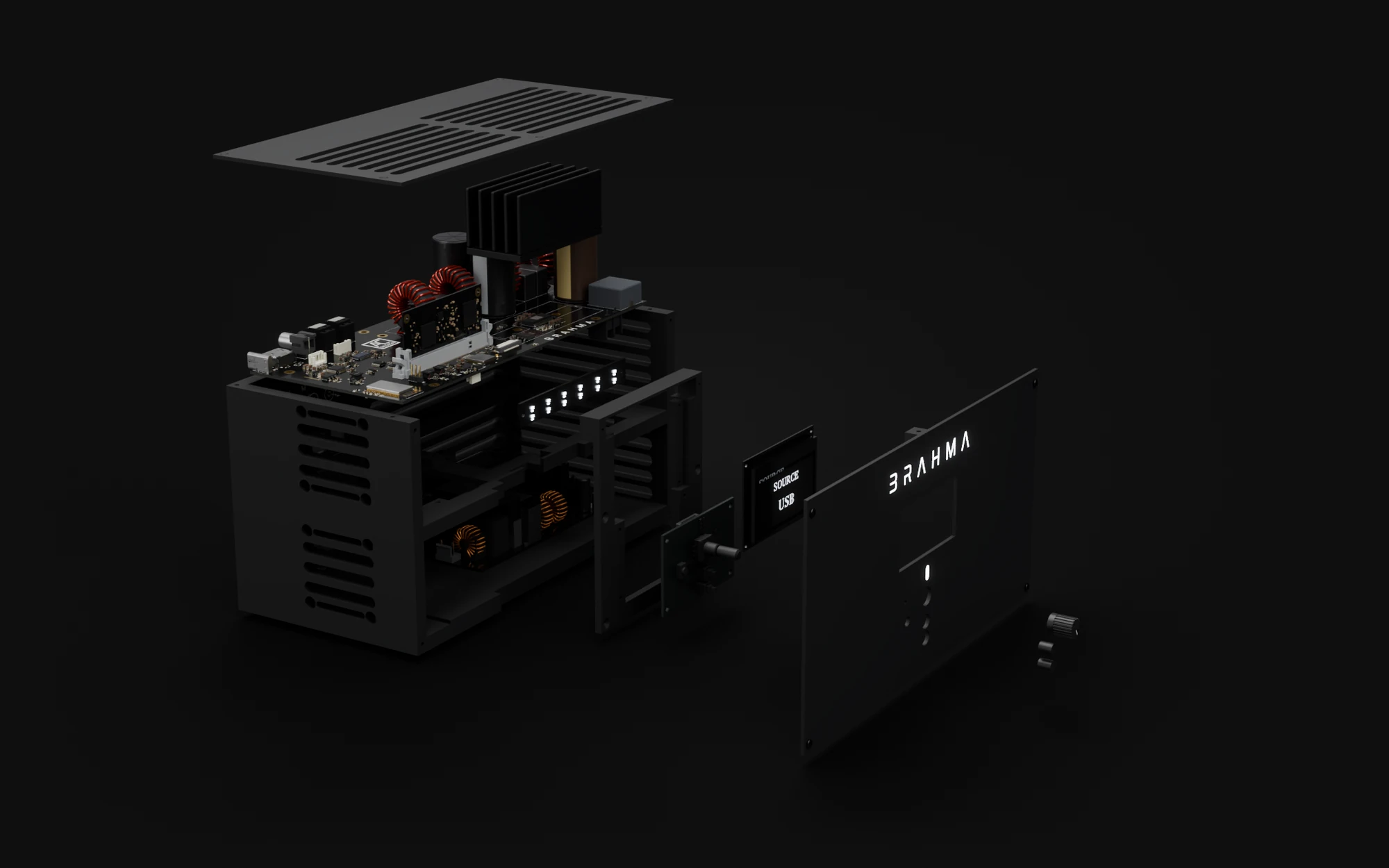
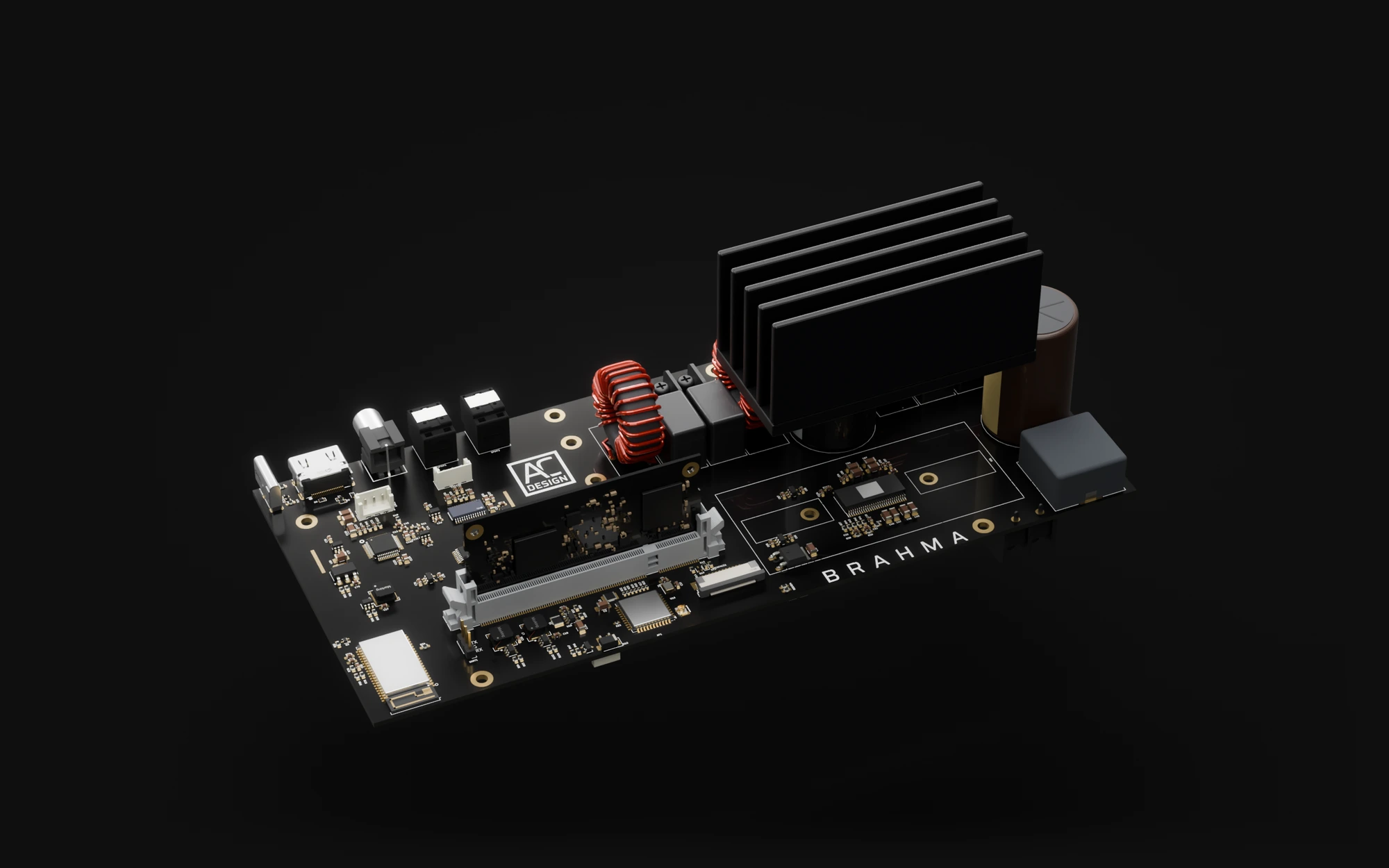
Every part is drawn from scratch: the schematics and circuit boards in KiCad, the enclosure and its inner structure in FreeCAD. A Raspberry Pi Compute Module 3+ running embedded Linux, a Digital Audio Interface Transceiver and a Bluetooth 5.1 HiFi audio module feed a Class-D stage through a programmable DSP.

Brahma coming apart: the top cover lifted, the amplifier board raised out of the enclosure with its heatsink above the TAS3251, the LED board that lights the letters, and the inner frame, control board, display, front panel and knob pulled forward, with the power supply in its place under the board

04 The power stage

Texas Instruments TAS3251.

The main output is built on the Texas Instruments TAS3251 — a Class-D amplifier with an on-board DSP, running at a fixed 36 V rail. The figures below are its rated capability.

The black amplifier board with the AC Design logo and BRAHMA in its silkscreen, the heatsink lifted off the TAS3251: the Compute Module 3+ standing in its socket, four red toroidal output filters, film and bulk capacitors and the speaker terminals
up to175W/chPower · 4 Ω≈ 80 W into 8 Ω
as low as0.008%THD + NDistortion and noise
better than108dBSNRA-weighted
up to90%EfficiencyLittle power lost as heat

On-board DSP

Parametric EQ
Tame the room, lift presence, tailor a signature
Clipper / limiter
Drivers protected, output composed at the extremes
Fine volume + mixing
Smooth, click-free level control and flexible routing
Sample-rate conversion
One clean internal rate for every source

Self-protection

Cycle-by-cycle current limit
Rides out demanding peaks without shutting down
Short-circuit
Guards against wiring faults, pin to pin
Two-stage thermal
An early warning, then a graceful shutdown
Under-voltage & reset
Clean starts and brown-out safety
DC speaker protection
Shields the drivers from a fault condition
Brahma from above: rows of ventilation slots across the top, the display reading SOURCE USB
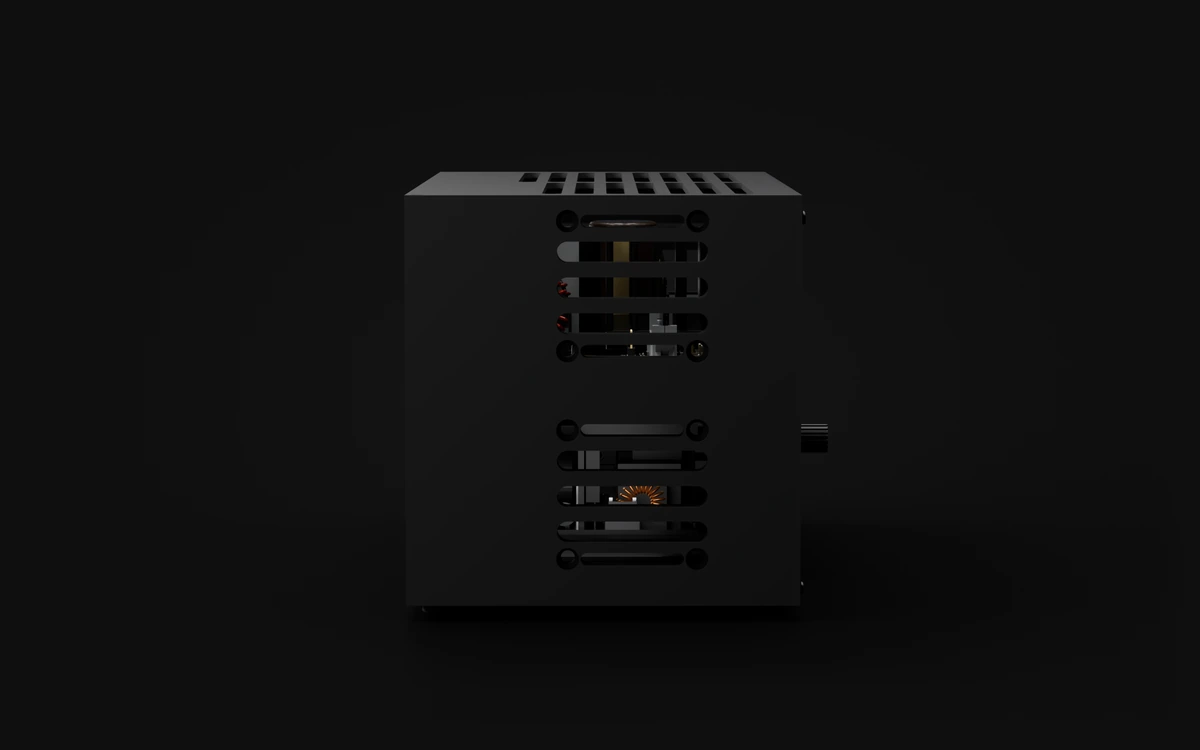
The left side of Brahma with two columns of rounded ventilation slots

05 The line output

Texas Instruments PCM5122.

A Burr-Brown DirectPath stereo DAC feeds a dedicated line-level output: a second pair of speakers, an active subwoofer, another amplifier or a recorder. It is ground-centred, so there are no coupling capacitors in the path and no turn-on thump, and it holds its performance into loads down to 1 kΩ.

rated112dBSNR & dynamic rangeA-weighted
at −1 dBFS−93dBTHD + N≈ 0.002 %
DirectPath2.1VRMSOutput levelNo coupling capacitors
better than100dBChannel separationA wide stereo image

06 What it will become

This is only the beginning.

Brahma is a foundation, not a finished thing. Building from the silicon up means nothing is fixed — and the same idea is already taking new shapes.

Planned

Brahma Maha

When the room outgrows the stage.

Sometimes the founding brahma builds a stage that’s too small for its audience. A bigger room, a bigger crowd, a bigger appetite for sound — same soul, same features, but with real muscle behind it. Everything you love about brahma, scaled up in power to fill the spaces the original was never asked to. It’s on the way.

Planned

Brahma Varana

Respect for what came before.

We know we’re new here. Great sound existed long before brahma, and we respect the machines that made it — beautiful amplifiers, warm and characterful, that time quietly set aside when the world went digital and left them without a modern way in. VARANA gives them that way in: all of brahma’s flexibility — every source, every stream, every input, and the freedom to tune and shape it with the same DSP — delivered cleanly as a reference line-out to the amplifier you already cherish. Your grandfather’s amp, rediscovered, fed by a modern brain — the past, playing today’s music, on its own terms.

Planned

Brahma Maun

The same world, up close.

Same flexibility. Same open, honest signal. Same freedom to choose and tune. Only now it’s built to drive your headphones, not your room. MAUN brings the whole brahma philosophy to the intimacy of a great pair of cans — every input, every stream, reproduced with the same care, poured straight into your ears.